
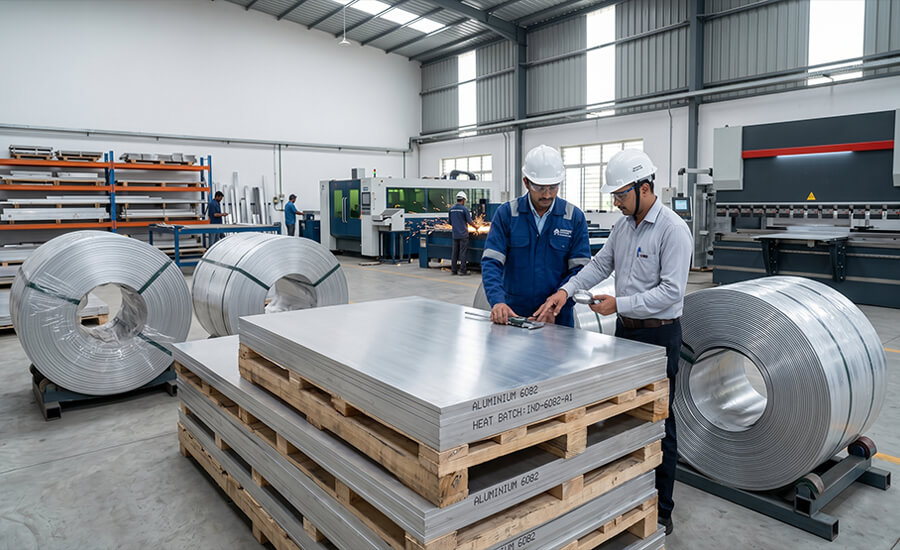
Aluminium 6082 Plate & Coil: Properties, Fabrication and Applications

Aluminium 6082 Plate & Coil is one of the most trusted materials in modern industry. It is strong, lightweight, and easy to work with. It also resists corrosion very well. That is why it is used in many structural and engineering projects. At Aluminium Tubes, we understand how important it is to choose the right alloy for performance, safety, and long service life.

What Is Aluminium 6082?

Aluminium 6082 is a medium-strength alloy in the 6000 series. It contains magnesium, silicon, and manganese. These elements give it a good balance of strength, corrosion resistance, and machinability. It is often called a structural alloy because it performs well in load-bearing jobs.

6082 is available in different forms, including plate and coil. The plate form is popular for machining and fabrication. The coil form is useful where continuous material supply is needed for processing. Both forms offer dependable performance in demanding environments.

Key Properties of Aluminium 6082

Aluminium 6082 has several important properties that make it a practical choice. It is strong enough for many industrial uses, yet still light compared to steel. This helps reduce total weight in machines, vehicles, and structures.

It also offers excellent corrosion resistance. This makes it suitable for outdoor use and marine environments. In addition, it has good weldability and machinability, which makes fabrication easier and faster. The alloy also has good thermal conductivity, so it can transfer heat efficiently in certain applications.

Here are some of the main properties:

  • Good strength-to-weight ratio.
  • Excellent corrosion resistance.
  • Good machinability.
  • Good weldability.
  • Suitable for heat treatment.
  • Reliable in structural applications.

Why Plate and Coil Forms Matter

The plate and coil formats serve different needs. Aluminium 6082 plate is thick, flat, and widely used in engineering and machining. It is ideal for parts that need strength and stability. It is also used for heavy-duty components, brackets, bases, and structural parts.

Aluminium 6082 coil is supplied in long rolled sheets. This form is useful for cutting, shaping, and mass production. It works well in industries that need continuous feeding during manufacturing. The coil form is common in processing lines where speed and efficiency matter.

Choosing between plate and coil depends on the project. If the job needs thick, rigid material, plate is better. If the process needs flexible feeding or repeated cutting, coil is often the right option.

Fabrication and Processing

Aluminium 6082 is easy to fabricate when the right methods are used. It can be cut, drilled, bent, welded, and machined with good results. This makes it a favorite for workshops and factories.

During machining, 6082 performs well and gives clean results. It is often used in plate form for precision parts. Its strength allows it to hold shape during cutting and shaping. This reduces waste and improves consistency.

Welding is also possible with Aluminium 6082. However, like many heat-treated alloys, the weld zone can lose some strength. That is why proper welding methods and post-weld planning are important. For best results, fabricators should use suitable filler metals and controlled heat input.

Cold forming is possible too, especially when the material condition is correct. Coil form is especially useful in operations that involve rolling, bending, or shaping into finished products.

Heat Treatment and Strength

Aluminium 6082 responds well to heat treatment. This is one reason it is so widely used. Heat treatment improves its strength and helps it perform better in demanding applications.

Common tempers include T6 and T651. These conditions are used when higher strength and better stability are needed. In simple terms, the alloy becomes harder and stronger after heat treatment. This makes it more suitable for structural and mechanical parts.

However, the improved strength should be balanced with the needs of the project. If a part needs more flexibility, another temper may be chosen. The final selection depends on the design, load, and environment.

Main Applications

Aluminium 6082 Plate & Coil is used across many industries. Its combination of strength and corrosion resistance makes it very versatile. It is found in transport, construction, marine, machining, and general engineering.

Common applications include:

  • Structural frames and supports.
  • Bridges and trusses.
  • Cranes and lifting equipment.
  • Machined parts and precision components.
  • Transport parts.
  • Marine structures and fittings.
  • Industrial equipment.
  • Architectural parts.
  • Pressure and load-bearing assemblies.

The plate form is often used in heavy-duty engineering. The coil form is often used in manufacturing and processing lines. Both forms are valuable where reliability matters.

Advantages Over Other Alloys

One major advantage of Aluminium 6082 is its balance of properties. It is stronger than many other 6000 series alloys. It also resists corrosion very well. This makes it a strong option for structural work.

It is also easier to machine than some harder alloys. That helps reduce production time and tooling wear. In many projects, it can replace older alloys when higher strength is needed. This is one reason it has become so popular in modern fabrication.

Another advantage is its wide availability in plate and coil forms. This gives designers and buyers more flexibility. It can be adapted to many different jobs without major changes in process.

How to Choose the Right Form

The choice between plate and coil should be based on use. For thick parts, load-bearing components, and machined pieces, plate is usually the better choice. It gives stability and strength.

For continuous production, cutting, and shaping, coil can be more efficient. It is useful when speed and volume are important. The final decision should also consider thickness, temper, finishing needs, and the working environment.

At Aluminium Tubes, we always recommend matching the alloy form to the application. This helps improve performance, reduce waste, and control cost.

Final Thoughts

Aluminium 6082 Plate & Coil is a powerful material for modern industry. It offers strength, corrosion resistance, and easy fabrication in one alloy. These qualities make it suitable for structural, marine, transport, and engineering uses.

Whether you need plate for machining or coil for production, Aluminium 6082 gives dependable results. It is a practical choice when performance and durability matter. That is why it continues to be one of the most respected aluminium alloys in the market, and why Aluminium Tubes is proud to highlight its value for professionals and manufacturers.
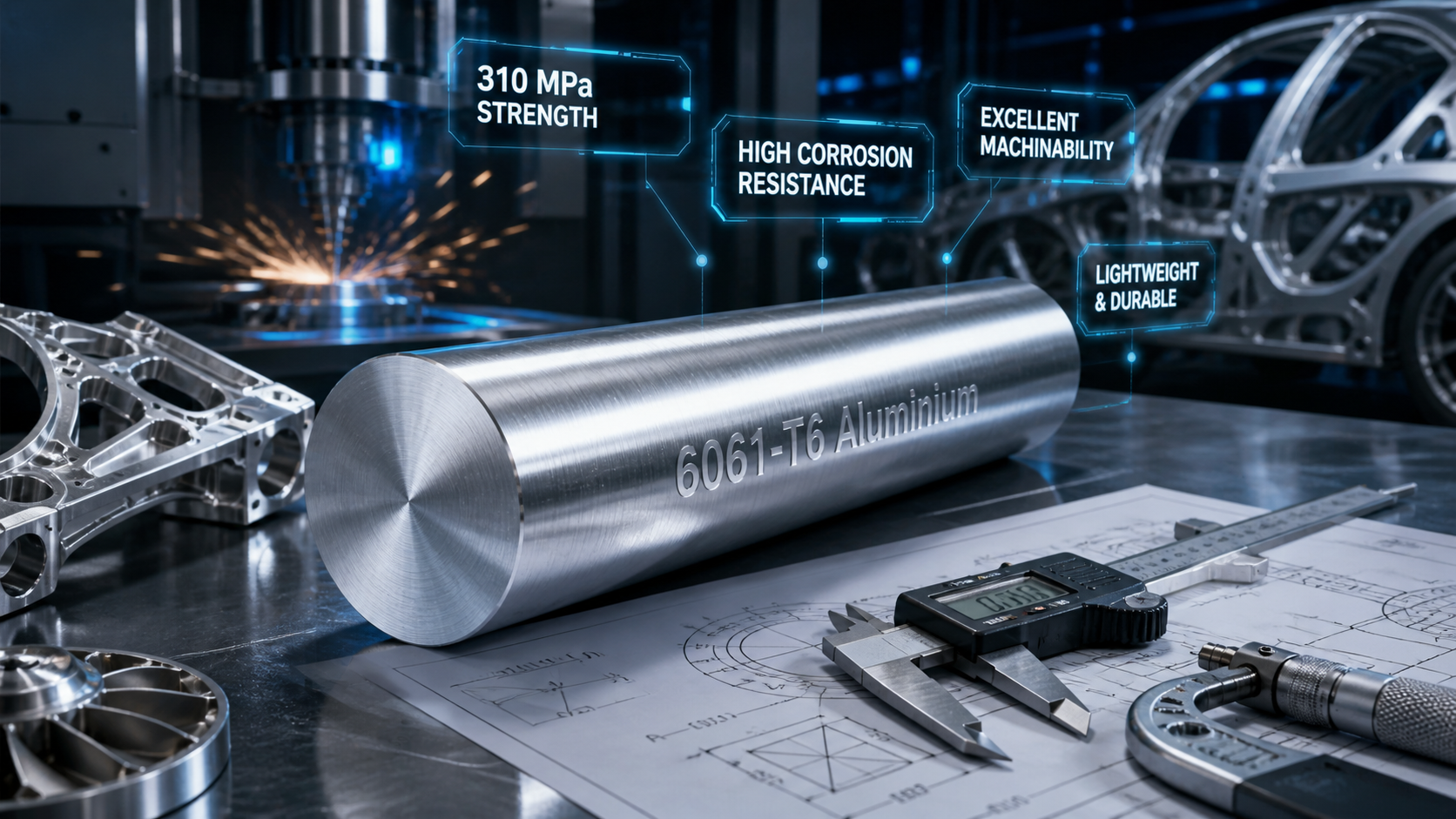
6061 T6 Aluminium Round Bar Explained: Strength, Price, and Why Your Next Project Needs It

What Is 6061 T6 Aluminium Round Bar?

6061 T6 aluminium round bar is a high‑strength, heat‑treated aluminium rod used in machines, structures, and industrial parts.
It is made from the 6061 aluminium alloy, which contains magnesium and silicon as main alloying elements.
The “T6” at the end means it has been solution‑heat‑treated and then artificially aged to increase its strength and hardness.

This round bar is supplied in long cylindrical lengths with a smooth, uniform diameter.
It is a popular choice for customers who want a light, strong, and corrosion‑resistant metal that still machines and welds easily.
At Aluminium Tubes, we keep 6061 T6 round bars in common industrial sizes and ready‑to‑use lengths.


Why Choose 6061 T6 Over Other Aluminium Grades?

Not all aluminium is the same. 6061 T6 is stronger than basic pure‑aluminium grades such as 1100 or 6063.
It also hardens through heat treatment, so it can carry more load than many other wrought aluminium alloys.

Compared with aerospace‑only alloys like 2024, 6061 T6 is more affordable and easier to weld.
You still get high strength‑to‑weight ratio, good fatigue resistance, and strong corrosion protection.

If your project needs a mix of strength, lightness, weldability, and low upkeep, 6061 T6 round bar is often the best compromise.
That is why engineers in USA and overseas use it for frames, shafts, brackets, and custom‑machined parts.

Also Read: Aluminium Tubes in Construction: 7 Powerful Uses You Need to Know

Key Properties of 6061 T6 Aluminium Round Bar

Mechanical Strength and Hardness

6061 T6 has a typical tensile strength of about 290 MPa and a yield strength in the range of 240–275 MPa.
This means it can handle strong pulling and bending forces without permanent deformation if the loads are within design limits.

The hardness after T6 treatment is around 95 Brinell (HB), which is solid for a structural aluminium.
This hardness makes the round bar suitable for parts that must resist wear, impact, or repeated stress cycles.

Lightweight and Easy to Handle

Like most aluminium alloys, 6061 has a density of about 2.70 g/cm³.
This is less than one‑third the weight of steel with comparable strength in many applications.

The low weight means easier handling, lower transport cost, and lighter machines or structures.
That is why 6061 T6 round bar is common in automotive, aerospace, and portable equipment frames.

Corrosion Resistance and Oxide Layer

6061 T6 has very good atmospheric and moisture‑based corrosion resistance.
When exposed to air, it forms a thin, self‑protecting oxide film that slows further oxidation.

This makes it suitable for outdoor structures, marine environments, and industrial settings with humidity or chemicals.
At Aluminium Tubes, we recommend 6061 T6 round bars for coastal projects and outdoor fencing, where rust resistance is a must.

Thermal and Electrical Properties

6061 T6 has a thermal conductivity of roughly 167–180 W/m·K, which is moderate but still useful for heat transfer.
It is often used in heat‑sink parts, brackets, engine supports, and cooling‑related components.

The electrical conductivity is about 40–43% IACS, which is lower than pure aluminium but still acceptable for many non‑critical electrical parts.
Because of its good strength and moderate conductivity, designers sometimes use it for light‑duty electrical fixtures or bus‑bar supports.


Dimensions, Sizes, and Tolerances

Standard Diameter Range

6061 T6 aluminium round bars are typically manufactured from small rods to large solid shafts.
Common diameters start from about 6 mm (¼ inch) and go up to 250–315 mm or more, depending on the supplier.

For industrial buyers, the usual range is from 10 mm to 300 mm in diameter.
This covers everything from small pins and axles to large structural columns and machine shafts.

Length Options

Standard 6061 T6 round bars are often supplied in fixed lengths between 12 feet and 12 meters (about 3.6 to 12 m).
Many suppliers and Aluminium Tubes also offer cut‑to‑length service so you can order bars exactly as per your drawing.

Custom lengths can be matched to CNC machining cycles or welding setups, reducing waste and improving shop‑floor efficiency.

Tolerance and Finish

Tighter dimensional tolerances are possible with turned or ground 6061 T6 round bars.
For example, for diameters from 6 mm to 18 mm, the permissible tolerance may be around +0 to −0.070 mm, and it gets slightly wider as the bar gets thicker.

Common surface finishes include:

  • Mill finish (as‑extruded, light‑textured surface).
  • Bright or polished finish for aesthetic or high‑precision parts.

These tight tolerances and clean finishes make 6061 T6 round bar ideal for CNC machining, turning, and grinding operations.

Also Read: Aluminum Round Tube Applications: Industrial Uses, Benefits, and Modern Engineering Solutions

Where Is 6061 T6 Aluminium Round Bar Used?

Because of its mix of strength, light weight, and corrosion resistance, 6061 T6 round bar appears in many industries.

Aerospace and Aviation

In aerospace Industry, 6061 T6 is used for frames, brackets, and structural fittings.
Its high strength‑to‑weight ratio helps reduce aircraft mass without sacrificing safety.

Even on the ground, 6061 T6 round bars support jigs, tooling, and inspection fixtures in aircraft‑assembly shops.

Automotive and Transport

In Automotive Industry engineers use 6061 T6 round bars for suspension parts, steering‑link components, motor mounts, and chassis brackets.
Lighter aluminium reduces fuel consumption and improves vehicle handling.

In rail and bus manufacturing, 6061 T6 rods help build frames, handrails, and interior fittings that must stay strong and rust‑free for years.

Marine and Offshore

Because of its good resistance to salt‑water‑like environments, 6061 T6 is trusted for marine structures and hardware. It popular in Marine and Shipbuilding Industry.
You can find 6061 T6 round bars in boat fittings, deck fittings, davit arms, and other underwater‑related components.

At Aluminium Tubes, we supply 6061 T6 round bars for coastal and river‑based projects in India where corrosion life is critical.

Industrial Machinery and Fabrication

Machinery shops use 6061 T6 round bars to make shafts, spindles, guides, and custom‑machined parts.
Its machinability and consistent hardness allow for excellent surface finish and tight tolerances on CNC lathes and mills.

Welded fabrication projects also use 6061 T6 round bars for frames, enclosures, and work supports.

Defence, Security, and Construction

In defence and security, 6061 T6 round bars go into lightweight weapon mounts, periscopes, and portable structures.
In construction, they support safety rails, equipment platforms, and temporary structures such as gantries and scaffolds.

Architects and interior designers sometimes use bevelled 6061 T6 round bars for stylish railings, balustrades, and decorative light fixtures.


How 6061 T6 Heat Treatment Works

The “T6” in 6061 T6 is a temper designation that tells you how the metal was treated after extrusion or rolling.

First, the 6061 alloy is heated to a high temperature (solution heat treatment) so that the alloying elements dissolve into the aluminium matrix.
Then it is quenched quickly with water or air to freeze this mix in place.

Later, the bar is reheated to a lower temperature (artificial aging) for several hours.
This aging step causes tiny magnesium‑ and silicon‑rich particles to form inside the metal, which strengthen the grain boundaries and raise hardness and yield strength.

Variants such as T651 and T6511 are special stress‑relieved T6 tempers used for precision shafts and bars that must hold strict straightness.


Advantages of Using 6061 T6 Round Bar

Using 6061 T6 aluminium round bar offers several clear benefits for manufacturers and fabricators.

  1. High strength without heavy weight – it is one of the strongest heat‑treatable aluminium alloys you can buy at a reasonable price.
  2. Excellent corrosion resistance – the natural oxide layer keeps it looking good and performing well in humid and outdoor locations.
  3. Easy to machine and weld – it cuts smoothly, drills well, and responds nicely to MIG and TIG welding when proper procedures are followed.
  4. Good fatigue strength – repeatedly loaded parts such as brackets and shafts tend to last longer in service.
  5. Cost‑effective for structural work – for many projects, it strikes a better balance of performance and price than high‑end aerospace alloys.

For Indian buyers, Aluminium Tubes offers bulk‑packed 6061 T6 round bars with ISO‑style quality control and consistent mechanical properties.


Comparison of 6061 T6 with Other Common Alloys

Here is a simple view of how 6061 T6 stacks up against other widely used aluminium alloys.

Property / Alloy 6061 T6 (round bar) 6063 T6 (architectural) 2024 T3 (aircraft‑grade)
Typical tensile strength ~290 MPa  ~200–230 MPa  ~450–480 MPa 
Yield strength ~240–275 MPa  Lower than 6061 T6  Much higher than 6061 
Corrosion resistance Very good  Excellent  Moderate, needs coating 
Weldability Good  Good  Limited 
Typical round‑bar use Machine shafts, frames, structural parts  Architectural profiles, rails  High‑stress aircraft parts 

From this table, 6061 T6 is the best “all‑rounder” when you want both strength and ease of fabrication.


How to Machine and Fabricate 6061 T6 Round Bar

Machining Tips

6061 T6 is known for its excellent machinability across milling, turning, drilling, and grinding.
Use sharp carbide or high‑speed‑steel tools and keep cutting speeds and feeds moderate to avoid built‑up edge and chatter.

Because aluminium is soft, take care to avoid smearing or burring at edges.
Deburring with a file or chamfer tool or using a light grinding pass will give a professional finish on 6061 T6 round bars.

Welding Guidelines

6061 T6 can be welded by MIG or TIG methods using suitable aluminium filler such as 4043 or 5356.
Before welding, clean the surface with a stainless‑steel wire brush or degreaser to remove oil and oxide.

Welded joints in 6061 T6 will lose some strength in the heat‑affected zone, so design the joint to avoid high‑stress points and consider post‑weld heat treatment if the project allows.

At Aluminium Tubes, we can guide you on suitable 6061 T6 round‑bar sizes and tempers for your machining and welding setup.


Surface Finishes and Customization Options

6061 T6 round bars can be supplied in several finishes to match your project needs.

  • Mill finish: The natural as‑extruded surface, slightly rough but solid for general fabrication.
  • Bright or polished finish: Mechanically polished for a smooth, shiny look that suits decorative and visible parts.
  • Anodized finish (via finishing shop): A clear or colored anodized layer can further improve corrosion resistance and appearance.

Customers often order 6061 T6 round bars with:

  • Custom cutting lengths.
  • Pre‑turned or ground diameters for high‑precision shafts.
  • Laser‑marked or tagged bars for easy identification in large projects.

If you share your drawings with Aluminium Tubes, we can supply 6061 T6 round bars with exact diameter, length, and finish so you can start machining right away.


Price and Factors That Affect 6061 T6 Round Bar Cost

The price of 6061 T6 aluminium round bar depends on several factors.

  • Aluminium metal index: The base price of aluminium on the global market.
  • Diameter and length: Larger and longer bars carry more metal and cost more per piece, though the rate per kg may stay similar.

Finish and precision: Polished, turned, or tight.

Final Words, 6061 T6 aluminium round bars offer a compelling blend of strength, lightness, and versatility that suits a wide range of industries—from aerospace and automotive to marine and general fabrication. By understanding its tempering, machinability, and corrosion resistance, you can design parts that perform reliably while keeping costs in check. If you’re building with Aluminium Tubes, you can count on consistent quality, precise tolerances, and tailored service to bring your project from concept to reality. Ready to elevate your next build with 6061 T6?