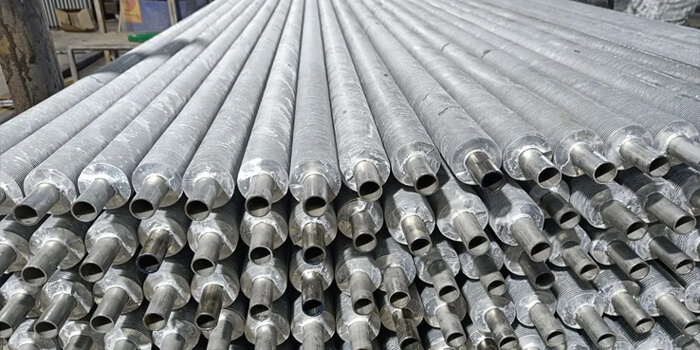
Finned Aluminum Tubes | Heat Exchanger Tube Manufacturer

Aluminium Tubes is a leading manufacturer, exporter, and supplier of finned aluminum tubes for heat exchangers, air-cooled condensers, radiators, and process cooling systems across the USA, UK, Europe, Middle East, and 80+ countries. By expanding the heat transfer surface 10–20x over a bare tube, finned tubes let engineers build smaller, lighter, and lower-cost cooling equipment.

We supply L-type, KL-type, G-type (embedded), and integral extruded finned tubes on 6061, 5083, 3003, and 1060 aluminum base tubes — plus aluminum fins on copper, carbon steel, and stainless base tubes — certified to ASTM B221, ASTM B234, and EN 754 with EN 10204 3.1 Mill Test Certificates.

Request a Quote for Finned Aluminum Tubes →

What Are Finned Aluminum Tubes?

Finned aluminum tubes are heat exchanger tubes with thin aluminum fins bonded to the outer surface, multiplying the air-side heat transfer area. Because air conducts heat far more poorly than the liquid or refrigerant inside the tube, the fins compensate — a 25mm bare tube gains 10–20x effective surface area once finned at 8–11 fins per inch (FPI).

The result: air-cooled heat exchangers that match water-cooled performance while eliminating water supply, treatment, and disposal costs entirely.

Types of Finned Aluminum Tubes We Supply

L-Type (Wrapped) Finned Tubes

Aluminum strip is tension-wound around the tube with an L-shaped foot covering the tube surface. Economical, good performance to 150°C. The most widely used type for air-cooled condensers and coolers.

KL-Type (Knurled) Finned Tubes

The tube surface is knurled before wrapping the L-foot fin, mechanically locking it in place. Better bond, service to 260°C, and superior resistance to thermal cycling than plain L-type.

G-Type (Embedded) Finned Tubes

The fin strip is wound into a machined groove and back-filled with tube material. Strongest mechanical bond — rated to 400°C and immune to fin loosening under vibration. Standard for refinery and power plant air coolers per API 661.

Integral Extruded Finned Tubes

Fins are extruded directly from an aluminum muff tube over the base tube — fin and tube are one piece with zero contact resistance. Best corrosion protection (base tube fully covered) and performance to 300°C. Ideal for marine and coastal installations.

Finned Tube Configurations & Specifications

Parameter Range / Value
Base Tube OD 9.52mm – 50.8mm (3/8″ – 2″)
Base Tube Wall 0.7mm – 3.0mm
Base Tube Materials Aluminum 6061/5083/3003/1060, copper, carbon steel, SS 304/316
Fin Material Aluminum 1100/1060 (also copper on request)
Fin Density 7 – 12 FPI (fins per inch)
Fin Height 9.5mm – 16mm
Fin Thickness 0.3mm – 0.5mm
Max Length Up to 12,000mm finned length
Standards ASTM B221, ASTM B234, EN 754, API 661 (G-fin)
Certification EN 10204 3.1 MTC; SGS/BV/TUV on request

Fin Type Comparison — Which One Do You Need?

Property L-Type KL-Type G-Type Extruded
Max Temperature 150°C 260°C 400°C 300°C
Bond Strength Good Better Excellent Integral (best)
Corrosion Protection Good Good Moderate (groove exposed) Excellent
Relative Cost Base +10–15% +25–35% +40–60%
Typical Use HVAC, coolers Process cooling Refinery air coolers (API 661) Marine, coastal

Applications of Finned Aluminum Tubes

Air-Cooled Heat Exchangers (ACHE): Refinery and petrochemical fin-fan coolers built to API 661 — G-type embedded fins are the specification standard.

HVAC & Refrigeration: Condenser and evaporator coils for air conditioning, cold rooms, and supermarket refrigeration — typically 3/8″ to 5/8″ tubes at 10–12 FPI.

Power Generation: Steam condensers, dry cooling towers, generator air coolers, and waste-heat recovery economizers.

Automotive & Transport: Radiators, charge-air coolers, oil coolers, and EV battery thermal management systems.

Industrial Process Cooling: Compressor intercoolers/aftercoolers, hydraulic oil coolers, and machine cooling circuits.

Marine Systems: Engine-room coolers and HVAC on vessels — extruded fins on 5083 base tubes resist salt-laden air. Pairs with our aluminium coiled tubes for refrigeration circuits.

Why Aluminum Fins? Thermal Performance Data

Aluminum’s thermal conductivity of 205–237 W/m·K (alloy dependent) is roughly 4x carbon steel (50 W/m·K), while weighing one-third as much. Compared to copper fins (385 W/m·K), aluminum delivers ~85% of the thermal performance at ~30% of the material cost and 30% of the weight — which is why aluminum fins dominate everything except the most compact or corrosive-duty designs.

When NOT to Choose Finned Aluminum Tubes

Honest guidance: skip finning when your fluid-to-fluid exchanger has liquids on both sides — bare tubes transfer fine there and fins add cost for nothing. In heavily fouling airstreams (cement dust, lint, flour), fins clog; use low-fin (7 FPI) designs or bare tube banks with soot blowers instead. And in acidic flue gas below dew point, aluminum fins corrode — specify carbon steel G-fin with coating or stainless instead.

Why Source Finned Aluminum Tubes From Us?

  • All 4 Fin Types: L, KL, G (API 661) and integral extruded
  • Multi-Material Base Tubes: Aluminum, copper, carbon steel, stainless
  • Certified: ASTM B221/B234, EN 754, EN 10204 3.1 MTC
  • Fin Bond Testing: Pull-off and thermal cycle tests documented
  • Long Lengths: Finned sections up to 12 metres for ACHE bundles
  • Custom Engineering: FPI, fin height and material to your thermal spec
  • Fast Export: Standard configurations in 2–3 weeks
  • 80+ Countries Served: USA, UK, Germany, UAE, Australia & more

Frequently Asked Questions — Finned Aluminum Tubes

What are finned aluminum tubes used for?

Finned aluminum tubes are used in air-cooled heat exchangers, HVAC condensers and evaporators, radiators, oil coolers, and refinery fin-fan coolers. The fins multiply air-side surface area 10–20x, letting air-cooled equipment match water-cooled performance.

How much do fins improve heat transfer?

Fins increase external surface area 10–20x depending on fin height and density. Overall heat exchanger duty typically improves 3–8x versus bare tube in air-cooling service, since air-side resistance dominates the thermal circuit.

What is the difference between L, KL, and G type fins?

L-type fins are tension-wrapped (to 150°C, most economical). KL adds knurling for better grip (to 260°C). G-type embeds the fin in a machined groove (to 400°C, API 661 standard) for refinery and power service.

What does FPI mean in finned tubes?

FPI means fins per inch — the fin density along the tube. HVAC coils typically use 10–12 FPI for maximum surface; dusty industrial environments use 7–8 FPI so passages resist clogging and clean easily.

Which base tube material should I choose?

Aluminum base (6061/3003) for lightweight all-aluminum coils; copper base for refrigerant systems with brazed joints; carbon steel for high-pressure process duty; 5083 or extruded-fin construction for marine and coastal atmospheres.

Are extruded finned tubes better than wrapped fins?

For corrosion and thermal cycling, yes — the extruded fin is integral with its muff, fully covering the base tube with zero contact resistance. They cost 40–60% more than L-type, justified in marine, coastal, and long-life installations.

Can you supply finned tubes to API 661?

Yes. G-type embedded fin tubes for air-cooled heat exchangers are supplied to API 661 requirements, including fin bond integrity testing and full material traceability with 3.1 certification.

What fin density and height do you recommend for HVAC?

For comfort HVAC condensers: 3/8″–1/2″ tubes, 10–12 FPI, 9.5mm fin height. For dusty rooftop or industrial units, drop to 8 FPI. Send your duty (kW, air flow, temperatures) and we’ll size it.

How are finned tubes tested before shipping?

Standard tests: dimensional inspection, fin pull-off bond test, and eddy current or hydrostatic test on the base tube. Thermal cycle testing and third-party witness (SGS/BV/TUV) available on request.

What is your MOQ and lead time for finned tubes?

Standard L-type configurations: 2–3 weeks with low MOQ suitable for coil repair shops. Custom G-type/extruded programs: 4–6 weeks, MOQ typically 100–300 metres. Send drawings for confirmation.

Related Products

Get a Quote for Finned Aluminum Tubes

Send us your base tube size and material, fin type, FPI, fin height, length, and quantity — or simply your thermal duty — and our team responds with pricing and lead time within 24 hours.

📞 Call/WhatsApp: +91 95166 18000
📧 Email: support@aluminiumtubes.org

Request Your Free Quote Now →

Contact our sales team today to discuss your requirements and request a competitive quote.

Need Help?

Call Us

+91 95166 18000

Mail Us

support@aluminiumtubes.org