
-
Address: 2, Reading Road,
Edison New Jersey, USA -
Address: 2, Reading Road,
Edison New Jersey, USA
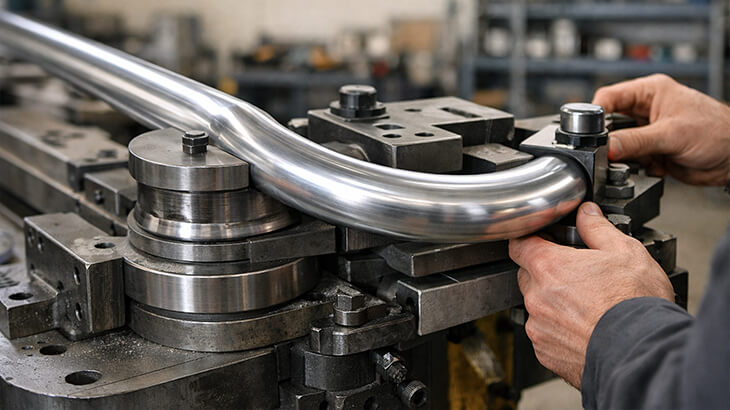
For fabricators, engineers, and DIY enthusiasts across the USA, there are few moments more frustrating than watching a pristine piece of aluminum round tube collapse into a jagged kink during a bend. Whether you are building a custom roll cage, fabricating intake piping for an automotive project, or designing architectural frames, the integrity of your bend matters. A kink isn’t just an aesthetic failure; it restricts flow and compromises structural strength.
At Aluminium Tubes, we understand that starting with high-quality material is only half the battle. The other half is the technique. Here is a comprehensive guide on how to achieve smooth, professional bends without the heartbreak of a kinked tube.
To prevent a kink, you have to understand the physics behind it. When you bend a tube, two opposing forces are at work: the outside wall of the tube stretches and thins out, while the inside wall compresses.
Kinking—often referred to as crimping—occurs when the tube folds or collapses inward because the material cannot withstand the compressive force, or the bend radius is too tight for the wall thickness. Essentially, without proper support, the tube takes the path of least resistance and folds rather than curving.
Before you even touch a bender, you must ensure you are using the right alloy and temper. Not all aluminum round tube is created equal.
Feasibility usually comes down to math. Professional benders use a calculation called the “Wall Factor” (Tube Outside Diameter ÷ Wall Thickness) and the “D of Bend” (Centerline Radius ÷ Tube OD).
Generally, the thinner the wall relative to the diameter, the harder it is to bend without support. A thin-walled tube (High Wall Factor) is highly susceptible to collapsing. If you are attempting a tight radius (less than 2 times the tube diameter) on a thin-walled tube, you cannot rely on simple force; you need internal support.
If you are wondering how aerospace or performance automotive shops get those perfect, tight bends, the answer is usually a mandrel.
A mandrel is a tool inserted inside the tube during the bending process. Its job is to support the interior walls to prevent them from collapsing or wrinkling while the die forms the curve. For standard bends, a plug mandrel might suffice, but for high-precision or thin-walled aluminum round tube, a flexible ball mandrel is often required. This tool consists of linked ball segments that flex inside the bend, providing continuous support throughout the radius.
Using a mandrel significantly reduces the risk of flattening (ovality) and kinking, ensuring the tube maintains its round cross-section.
Not everyone has access to a CNC mandrel bender. If you are working from a home shop with a manual bender, you can still achieve kink-free results by creating a “poor man’s mandrel” using sand.
Here is the process:
This method is time-tested and effective for preventing kinks and flattening in thin-walled tubes when professional tooling isn’t available.
Even with the right tools, things can go wrong. Here are quick fixes for common issues:
Whether you are using a rotary draw bender with a wiper die and mandrel, or packing sand for a one-off prototype, the quality of your finished product starts with the quality of your tube.
At Aluminium Tubes, we supply premium grade aluminum round tube tailored to the US market. We can help you select the correct wall thickness and temper to ensure your project succeeds—straight or curved. Don’t let poor-quality metal be the reason your project kinks.
Ready to start your next fabrication project? Browse our inventory today and find the material that bends to your will, not the other way around.
+91 95166 18000
support@aluminiumtubes.org

December 18, 2025
October 16, 2025

December 11, 2025