-
Address: 2, Reading Road,
Edison New Jersey, USA -
Address: 2, Reading Road,
Edison New Jersey, USA
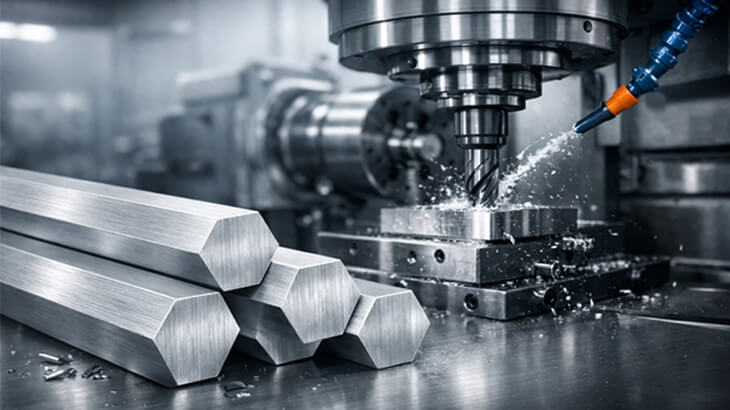
In the competitive landscape of American manufacturing, efficiency is the currency of success. For machine shops operating Swiss-style lathes, sliding headstock machines, or automatic screw machines, the geometry of the raw material is often just as critical as the alloy itself. While round stock remains the industry standard for shafts and rotational parts, the specific advantages of hexagonal profiles are transforming how shops approach high-volume component production.
At Aluminium Tubes, we recognize that material selection is the first step in cycle-time reduction. This guide explores the engineering advantages of hex bars and helps you navigate the technical trade-offs between the most common alloys used in US production today.
The primary argument for using hexagonal bars is “near-net shape” manufacturing. If a component requires wrench flats—such as a nut, a standoff, or a hydraulic fitting—starting with round stock necessitates milling operations to create those flat surfaces. This not only consumes machine time but also turns expensive raw material into scrap chips.
The Hexagonal aluminum bar benefits are immediate and measurable:
The most ubiquitous application for this profile is the production of aluminum hex bar fasteners. In industries ranging from automotive to marine engineering, aluminum fasteners offer a critical weight advantage over steel while maintaining sufficient strength for non-structural or semi-structural applications.
Hex bars are the ideal feedstock for screw machine products like nuts, bolts, and threaded standoffs,. Because the external hexagonal shape is pre-formed, the machining process focuses almost entirely on drilling, tapping, and parting off. This streamlined workflow is essential for keeping per-unit costs low in mass production. Furthermore, aluminum’s natural ability to form a protective oxide layer makes these fasteners excellent for environments where corrosion resistance is required alongside lightweight characteristics,.
While standard alloys work well for general fasteners, aerospace and high-performance automotive applications often demand materials that rival the strength of steel. This is where 7075 hex bar strength becomes the defining factor.
Alloy 7075 is one of the highest-strength aluminum alloys available, with a tensile strength that can exceed 80,000 psi (560 MPa), nearly double that of standard structural aluminum,. It is frequently utilized in high-stress components such as:
However, this strength comes with trade-offs. 7075 is generally considered non-weldable by arc welding methods due to solidification cracking issues,. For precision fasteners in critical load-bearing scenarios where welding is not required, 7075 provides an unbeatable strength-to-weight ratio.
For most machine shops, the daily choice isn’t about aerospace-grade strength, but rather ensuring the machines run smoothly without jamming. This leads to the common debate of 6061 vs 6262 hex bar machinability.
6061 is the jack-of-all-trades. It offers excellent corrosion resistance and weldability, making it the go-to for structural frames and custom brackets,. However, in high-speed screw machining, 6061 can produce continuous, stringy chips that may wrap around tooling or clutter the work envelope. While it anodizes beautifully, managing chip evacuation requires careful attention to feed rates and chip breakers.
If your project involves high-volume production of threaded fittings or nuts, 6262 is often the superior choice. Designed specifically for machinability, 6262 typically contains additions of bismuth and lead. These elements act as internal chip breakers, causing the metal to shear into small, manageable chips rather than long stringers,.
Sourcing the right material is about more than just finding the lowest price per pound; it is about finding a partner who understands tolerances and straightness.
As your dedicated aluminum bar supplier, Aluminium Tubes recognizes that in Swiss machining, bar straightness is paramount to prevent vibration and “bar whip” at high RPMs. We understand the difference between extruded stock (standard tolerances) and cold-finished stock, which offers the tighter dimensional controls (h9 or h11 tolerances) necessary for precision collets,.
Whether you need the free-machining capabilities of 6262 for a 10,000-part run or the sheer structural might of 7075 for a prototype, we supply the certified materials that keep American spindles turning.
From the time-saving geometry of aluminum hex bar fasteners to the impressive capabilities of 7075 hex bar strength, the hexagonal profile is a staple of modern precision manufacturing. By selecting the correct alloy—weighing the 6061 vs 6262 hex bar machinability factors—you can optimize your production line for both speed and quality.
Aluminium Tubes is ready to assist you in selecting the perfect profile and alloy for your next project
+91 95166 18000
support@aluminiumtubes.org

October 16, 2025
October 16, 2025