-
Address: 2, Reading Road,
Edison New Jersey, USA -
Address: 2, Reading Road,
Edison New Jersey, USA
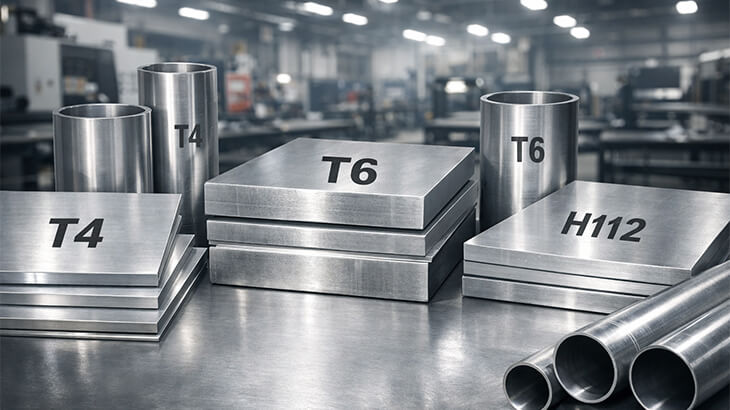
If you have ever shopped for metal materials in the USA, you know that buying an aluminum bar isn’t as simple as just picking a size. You are often met with a string of cryptic letters and numbers following the alloy grade, such as “6061-T6” or “5083-H112.”
For DIY enthusiasts, engineers, and fabricators alike, these codes—known as temper designations—are the difference between a project that succeeds and one that snaps under pressure. At Aluminium Tubes, we believe that knowing your materials is just as important as the design itself.
In this guide, we will get the aluminum temper designation explained in plain English, focusing on the three most common designations you’ll encounter: T4, T6, and H112.
While the alloy number (like 6061 or 3003) tells you what ingredients are in the metal (magnesium, silicon, copper, etc.), the temper tells you what the metal has been through to get to its current state.
Aluminum can be strengthened through heat treatment or strain hardening (cold working). The Aluminum Association uses a standard system to identify these treatments. The letter generally indicates the basic treatment class:
Let’s dive into the specific tempers you are most likely to find on our shelves.
When you see “T6,” think “maximum strength.” This is the gold standard for structural applications.
The T6 temper definition refers to a process where the aluminum is solution heat-treated and then artificially aged. In practical terms, the metal is heated to a high temperature, cooled (quenched), and then held at a lower elevated temperature in a furnace for a specific time to lock in its mechanical properties.
Why choose T6?
However, this strength comes with a trade-off. T6 aluminum has lower ductility (around 8–10% elongation), meaning it is harder to bend without cracking compared to softer tempers.
Best Uses: Bicycle frames, automotive chassis, aerospace structures, and heavy-duty structural components.
If T6 is the strong, rigid sibling, T4 is the flexible one. The T4 designation means the metal was solution heat-treated and then naturally aged to a stable condition,. Instead of being baked in a furnace to age (like T6), it is allowed to age at room temperature.
Why choose T4?
If you try to bend a T6 bar 90 degrees, it might snap. If you do the same with a T4 bar, it is much more likely to bend cleanly. Interestingly, some fabricators form the metal in the T4 state and then artificially age it to T6 afterward to get the best of both worlds.
The H112 designation is unique and often misunderstood. Unlike T-tempers, which rely on heat treatment, H-tempers are generally for non-heat-treatable alloys (like the 5000 series).
H112 applies to products that acquire some temper (hardening) just from the shaping process itself—usually extrusion or hot rolling—without special control over the amount of strain hardening,. However, unlike “As Fabricated” (F) materials, H112 products must still meet specific mechanical property limits.
H112 aluminum bar uses typically involve the 5000-series alloys, such as 5083. This temper is common in:
If you are looking for a marine-grade aluminum bar that offers moderate strength and high corrosion resistance, you will likely be looking at an H112 specification.
Knowing how to choose aluminum temper comes down to three main questions regarding your project’s needs:
Once you have selected the right alloy and temper, you often have to consider the finish. At Aluminium Tubes, we see high demand for black aluminum flat bar.
Usually made from 6061-T6 or 6063-T5, these bars are often anodized. Anodizing is a surface treatment that thickens the natural oxide layer on the aluminum part. This not only creates a sleek, professional black finish but also increases corrosion resistance and surface hardness. Whether for architectural trim, custom furniture, or framing, a black anodized flat bar provides a “finished” look right off the shelf, saving you painting time.
Whether you are an engineer specifying materials for an aerospace application or a hobbyist building a custom rig in your garage, understanding the difference between T6 strength, T4 formability, and H112 utility is essential.
At Aluminium Tubes, we are dedicated to helping our US customers find the exact grade and temper they need. From high-strength structural tubes to versatile aluminum bar stock, we have the inventory and the expertise to get your project moving.
Need help selecting the right aluminum for your next build? Browse our catalog today or contact our support team for expert advice.
+91 95166 18000
support@aluminiumtubes.org