
-
Address: 2, Reading Road,
Edison New Jersey, USA -
Address: 2, Reading Road,
Edison New Jersey, USA
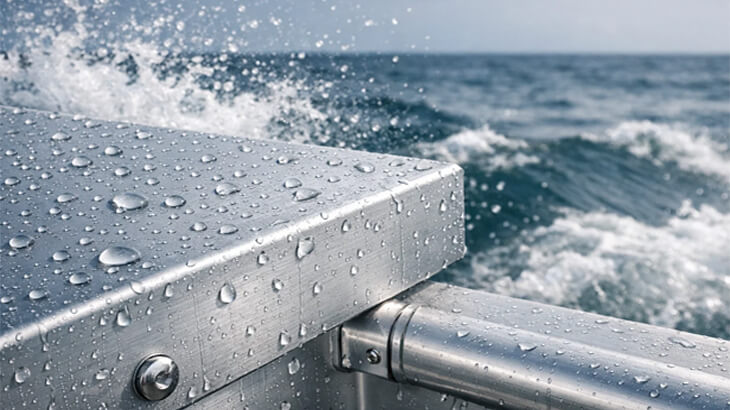
For boat builders, marine engineers, and coastal property owners, the battle against the elements is constant. Saltwater is notoriously unforgiving, capable of corroding standard metals in a fraction of their expected lifespan. This is where the right material makes all the difference. At Aluminium Tubes, we understand that selecting the correct alloy isn’t just about durability—it is about safety, efficiency, and longevity.
Whether you are retrofitting a sailboat mast, designing a new hull, or sourcing piping for an offshore rig, understanding “marine grade” is essential. This guide explores why specific aluminum alloys rule the waves and how to choose the right one for your project.
While pure aluminum naturally offers a level of protection, it is generally too soft for structural applications. To create “marine grade” metal, aluminum is alloyed—mixed with other elements like magnesium or silicon—to enhance its strength and durability while maintaining its ability to withstand harsh environments.
The term “marine grade” generally refers to alloys that belong to the 5xxx and 6xxx series. These materials are celebrated for their high strength-to-weight ratio; in fact, an aluminum hull can be 40% to 50% lighter than a steel equivalent, leading to shallow draughts and lower fuel consumption.
Most importantly, these alloys are categorized as corrosion resistant aluminium. Unlike steel, which requires constant painting to prevent rust, marine grade aluminum spontaneously forms a thin, impervious oxide layer that shields the metal from further oxidation. This natural self-healing mechanism is what makes it the material of choice for everything from pleasure boat superstructures to merchant ships.
When browsing our inventory at Aluminium Tubes, you will likely encounter these two dominant families of alloys. Understanding the difference is key to your project’s success.
The 5xxx series is alloyed primarily with magnesium. These are non-heat treatable alloys known for their excellent resistance to seawater and industrial chemicals.
For our customers at Aluminium Tubes, the 6xxx series is often of particular interest because these alloys are easily extruded into complex shapes, including tubes, bars, and profiles.
Even high-quality corrosion resistant aluminium requires proper care to maximize its lifespan. While the metal’s oxide layer offers superb protection, marine environments present unique challenges like galvanic corrosion.
This occurs when aluminum is electrically connected to a different metal (like a stainless steel propeller shaft) while submerged in an electrolyte (seawater). The aluminum can act as an anode and corrode to protect the other metal.
To prevent this:
While marine grade aluminum technically does not require paint for protection, many owners choose to paint for aesthetics or antifouling. Preparation is critical. The surface must be meticulously cleaned and sanded to remove old oxidation, followed by the application of an epoxy primer to ensure a strong bond.
Navigating the specifications of marine alloys can be complex. For instance, did you know that while 5083 is stronger, 6082 has a finer grain structure that makes it excellent for resisting dynamic loading conditions?
At Aluminium Tubes, we specialize in providing top-tier aluminum products that meet the rigorous demands of the American marine industry. Whether you need 6082 structural tubing for a new T-top frame or 5083 plate for a hull repair, we ensure you get the specific grade required for safety and performance.
Ready to start your project? Contact Aluminium Tubes today to discuss your requirements. We are here to help you build lighter, stronger, and smarter.
+91 95166 18000
support@aluminiumtubes.org
February 26, 2026
October 16, 2025
December 25, 2025