-
Address: 2, Reading Road,
Edison New Jersey, USA -
Address: 2, Reading Road,
Edison New Jersey, USA
For many of us in the United States, aluminum is a part of daily life. It’s in the vehicles we drive, the buildings we work in, and the devices we use to communicate. But have you ever stopped to consider the journey this metal takes before it becomes a finished product?
At Aluminium Tubes, we believe that understanding the materials you use is the first step to successful fabrication and construction. Whether you are an engineer, a contractor, or a DIY enthusiast, knowing the supply chain ensures you are selecting the right grade and quality for your project.
Here is a deep dive into the fascinating world of aluminum production, from the red earth of the tropics to the high-tech extrusion lines that create our products.
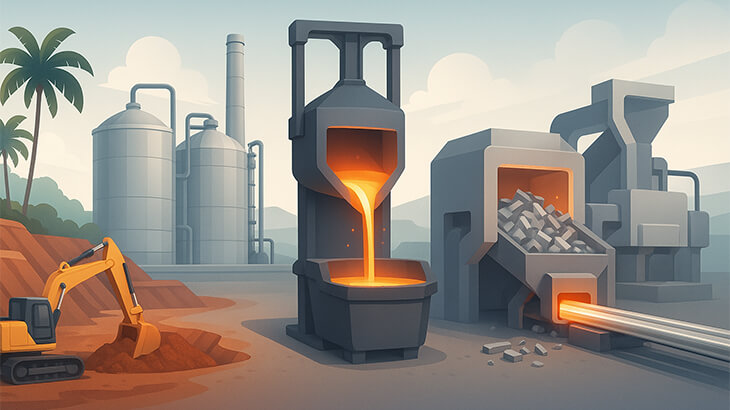
The lifecycle of every aluminum tube begins with bauxite. Bauxite is a reddish clay ore found primarily in the topsoil of tropical and subtropical regions. It is one of the most abundant elements in the Earth’s crust, containing 30–60% aluminum oxide.
While the US produces some bauxite, the vast majority of the world’s reserves are found in countries like Guinea, Australia, Brazil, and Vietnam. The ore is mined, crushed, and washed to remove clay and silica before being transported to refineries.
Once mined, the bauxite must be transformed into alumina (aluminum oxide). This is achieved through a chemical procedure known as the Bayer process, developed in the late 19th century.
The result is a fine, white powder: pure alumina. It takes roughly two pounds of alumina to produce a single pound of aluminum metal.
Turning that white powder into molten metal requires massive amounts of energy. This stage, known as primary aluminium production, utilizes the Hall-Héroult process.
The alumina is dissolved in a bath of molten cryolite (a salt) within a large steel pot lined with carbon. A powerful electric current is passed through the mixture via carbon anodes. This current breaks the chemical bond between the aluminum and the oxygen. The oxygen reacts with the carbon anode to create carbon dioxide, while pure liquid aluminum sinks to the bottom of the pot.
The molten metal is siphoned off and cast into various forms, such as ingots for rolling or billets for extrusion.
While the primary smelting process is energy-intensive, aluminum has a distinct advantage: it is 100% recyclable without any loss of properties. This is where secondary aluminum production comes into play, a sector that is vital to the US manufacturing landscape.
Secondary production involves melting down scrap aluminum—from used beverage cans to old window frames—rather than extracting it from ore. The difference in energy consumption is staggering. Producing secondary aluminum requires 95% less energy than primary production.
Increasing aluminum recycling rates by just 10% can decrease processing gas emissions by up to 15%. Because the metal retains its performance characteristics, the recycled material can be reformed into high-performance products again and again.
Once the aluminum is cast into billets (logs of aluminum), it is ready for fabrication. This is the stage where Aluminium Tubes steps in to provide value to our customers.
One of the most common methods for creating tubes is extrusion. Imagine squeezing toothpaste out of a tube; aluminum extrusion works on a similar principle. The aluminum billet is heated until it is malleable (soft but not liquid) and forced through a steel die with a specific cross-sectional profile.
This process allows for the creation of complex shapes, including round, square, and rectangular tubes, with precise tolerances. The resulting products offer an exceptional strength-to-weight ratio and natural corrosion resistance, making them ideal for aerospace, construction, and industrial machinery.
The industry is currently undergoing a revolution to become greener. Innovations are rolling out globally to reduce the carbon footprint of primary aluminium production. For example, new “inert anode” technology is being developed to release oxygen instead of carbon dioxide during smelting. Furthermore, manufacturers are increasingly integrating hydrogen power and solar energy into the refining process to move toward Net Zero emissions.
Understanding the complexity of the manufacturing process highlights why quality control matters. From the purity of the alloy during smelting to the precision of the die during extrusion, every step affects the final strength and finish of the product.
At Aluminium Tubes, we are dedicated to sourcing materials that meet the highest standards of production and sustainability. Whether you need materials for a high-stress structural framework or a custom design project, we ensure that the metal you receive has been crafted for performance.
Ready to start your next project? Browse our extensive inventory or contact our team today to find the perfect profile for your needs. Let us help you build with the strength and versatility of aluminum.
+91 95166 18000
support@aluminiumtubes.org